● Start here
For open enrollment: HSA, FSA and Medicare
Open enrollment runs October through December: these free calculators and worksheets help you pick a health plan and use your FSA or HSA money correctly before the deadline.
Free toolsno sign-up
Tested spreadsheets
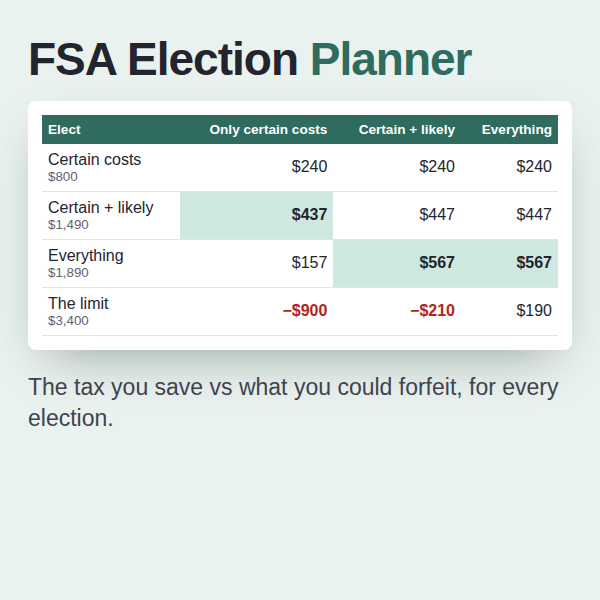
FSA Election Planner
How much to put in your health FSA: the tax you save vs what you could forfeit, plus a medical expense log.
✓ 103 formulas · 0 errors · checked claim by claim through the year$6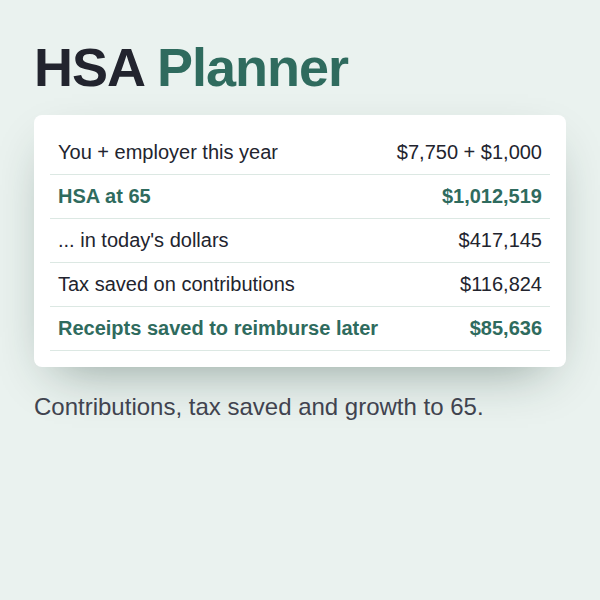
HSA Planner
Contributions within the limit, the tax you save, and your HSA year by year to 65: paying bills vs saving receipts.
✓ 513 formulas · 0 errors · every year checked independently$6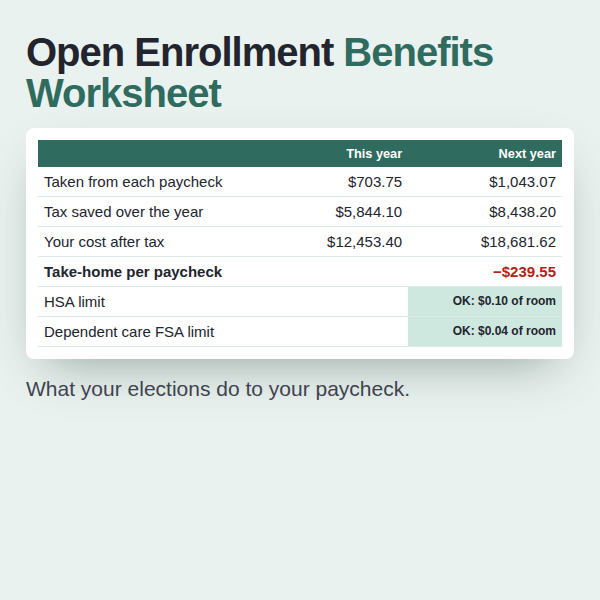
Open Enrollment Benefits Worksheet
Every election this year vs next: per paycheck, tax saved, the change in take-home pay, and HSA / FSA / 401(k) limit checks.
✓ 261 formulas · 0 errors · every result recomputed independently$6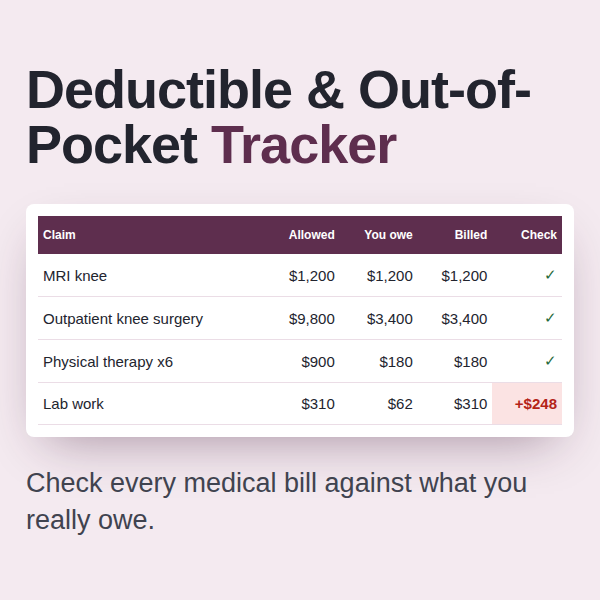
Deductible & Out-of-Pocket Tracker
What you should owe on each medical claim, mismatched bills, and your deductible and out-of-pocket progress.
✓ 1,013 formulas · 0 errors · every claim checked independently$6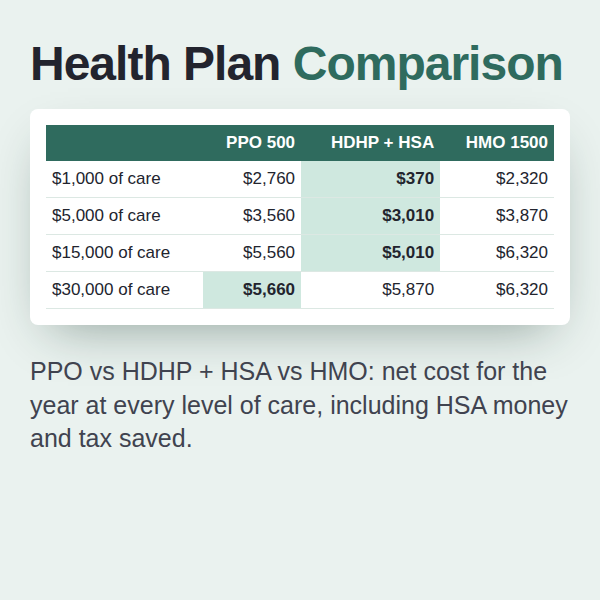
Health Plan Comparison
PPO vs HDHP + HSA vs HMO: what each plan really costs you in a year, at every level of medical spending.
✓ 106 formulas · 0 errors · checked claim by claim through the year$7Guidesworked examples
- What happens to unused FSA money: the year-end deadline, grace period and carryover
Unused health FSA money is forfeited at plan-year end unless your employer's plan adds a grace period (2.5 more months, any amount) or a carryover (up to $680 for 2026 plan years) -- never both, and it's the employer's choice, not yours. Dependent care FSAs don't get the carryover. How to find out which one your plan has, and two worked examples.
- Medicare Advantage vs. Original Medicare (2026) -- and the HSA trap if you're still working past 65
Original Medicare vs. Medicare Advantage for 2026 Open Enrollment (Oct 15 - Dec 7): provider networks, Medigap, Part D, and out-of-pocket maximums, with the official 2026 Part A and Part B costs. Plus the HSA trap few sites cover -- enrolling in Medicare Part A after 65 can be backdated up to 6 months and turn recent HSA contributions into an excess contribution with a 6% excise tax.
- IRMAA 2026: Medicare's income surcharge is a cliff, not a phase-in
The full 2026 IRMAA tier table for Medicare Part B and Part D, both filing statuses, with a worked example showing how a $200 difference in MAGI two years ago adds $1,736.40 a year to Medicare premiums -- and why a December Roth conversion or QCD choice today sets the MAGI that triggers it.
- How to appeal a Medicare IRMAA surcharge: Form SSA-44 and the 8 life-changing events
How to appeal an IRMAA Medicare surcharge with Form SSA-44 after a life-changing event -- the 8 events SSA recognizes (marriage, divorce, death of a spouse, work stoppage or reduction, loss of income-producing property, loss of pension income, employer settlement payment), the exact evidence each one requires, how and where to file, and what SSA does if it approves the request.
- How much will my prescriptions cost under Medicare Part D in 2026?
The 2026 Medicare Part D standard benefit, phase by phase: the $615 deductible, 25% initial-coverage coinsurance, and the $2,100 annual cap on cash out-of-pocket drug costs, with worked examples.
- FSA vs HSA: which should you choose during open enrollment
During open enrollment (Oct 15 - Dec 7, 2026), a general-purpose health FSA and an HSA-eligible HDHP are usually mutually exclusive -- IRS Publication 969 treats the FSA as "other health coverage" that disqualifies you from the HSA. The fix is often a limited-purpose or post-deductible FSA instead. A worked example of what re-electing the wrong FSA out of habit costs in lost HSA tax savings.
- Open enrollment for 2027: HSA, HDHP and dependent care FSA limits, and HSA per paycheck
The benefit numbers you choose this fall apply to 2027: HSA $4,500 / $9,000, HDHP minimum deductible $1,750 / $3,500, dependent care FSA $7,500. What each is, what isn't announced yet, and HSA contributions per paycheck.
- How to check a medical bill against your EOB: a worked example with deductible, coinsurance and out-of-pocket max
Seven claims on a $3,000 deductible, 20% coinsurance plan, worked through in date order: $4,932 is owed, and a $310 lab bill should be $62. Why the order of claims matters, and what happens at the out-of-pocket maximum.
- How much will an HSA or 401(k) contribution reduce my paycheck? Tables for 2027
A pre-tax deduction takes less from your take-home pay than it puts away. Tables: the 2027 HSA maximum per paycheck by tax bracket, and $500 a paycheck to a pre-tax 401(k), a Roth 401(k) or through the cafeteria plan.
- HSA limit for a partial year: month by month, or the last-month rule (2027 tables)
Starting a high-deductible plan mid-year, switching to family coverage or enrolling in Medicare changes your HSA limit. How the month-by-month limit and the last-month rule work, with 2027 tables and the IRS examples.
- Family health insurance: my plan, my spouse's, or split? A worked example
When both parents can get health insurance at work, splitting the family between the two plans can beat putting everyone on one. A worked example with a spousal surcharge, embedded vs aggregate deductibles, and what changes when one person has a costly year.
- How much to put in your FSA: a worked example with the 2026 limit and carryover
A worked FSA example: $800 of certain costs, $690 likely, $400 maybe. What each election saves in tax and what it could forfeit, with and without the $680 carryover, and the rule behind it: elect a cost only if you're more than 1 − your tax rate sure of it.
- HSA: pay medical bills from it, or pay yourself and save the receipts?
A worked HSA example from age 35 to 65: maxing a family HSA with $1,800 a year of medical bills. Paying the bills from the HSA leaves $813,546; paying them yourself and saving the receipts leaves $1,012,519 plus $85,636 you can reimburse tax-free.
- HDHP vs PPO: when the high-deductible plan with an HSA really costs less
A worked open-enrollment example: a $180-a-month PPO against a $60-a-month HDHP with a $3,300 deductible. The HDHP costs less up to $18,250 of care, but only because of the HSA money. Without it, the PPO wins from about $2,300.