● Start here
For landlords and short-term rental hosts
Cash flow, cap rate, cash-on-cash and Airbnb occupancy, calculated correctly: free tools, worked examples and tested trackers.
Free toolsno sign-up
Tested spreadsheets
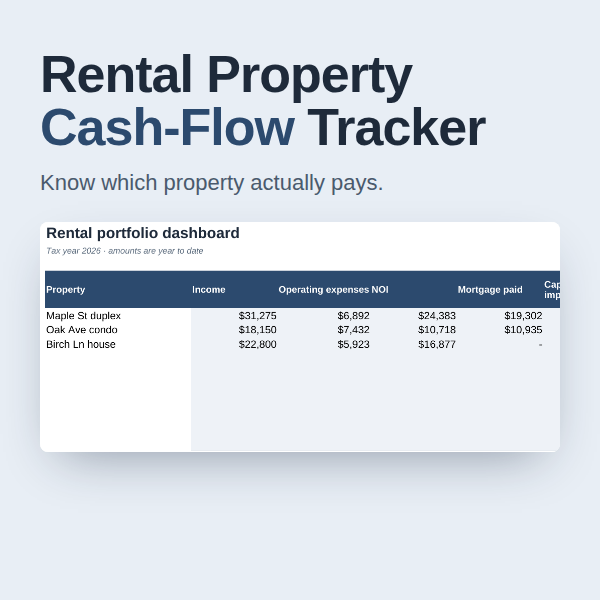
Rental Property Cash-Flow Tracker
Up to 10 properties: NOI, cap rate and cash-on-cash computed correctly, with the mortgage calculated and capex kept out of NOI.
✓ 0 formula errors · mortgage and every metric checked independently$12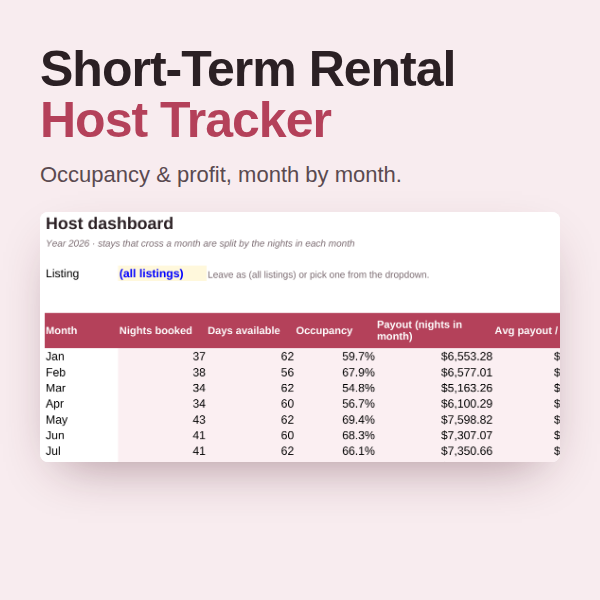
Short-Term Rental Host Tracker
Occupancy, payout per night and net income per month for Airbnb, Vrbo and direct stays, with stays that cross months split correctly.
✓ 4,598 formulas · 0 errors · matches a night-by-night calculation$12Guidesworked examples
- When does PMI come off? Payment-by-payment dates for 3% to 15% down, and what extra payments change
On a $350,000 home at 6.5%, PMI can be cancelled on request at payment 124 with 5% down and payment 56 with 15% down; automatic removal comes 11–19 payments later. $200 a month extra brings the 5%-down date to payment 84 and saves $5,542 of PMI.
- Rent vs buy by price-to-rent ratio: when buying pulls ahead at ratios from 10 to 30
The year buying pulls ahead of renting for a $400,000 home at price-to-rent ratios from 10 to 30, at 5.5%, 6.5% and 7.5% mortgage rates and 2%–5% home price growth. At a ratio of 15 buying wins in year 8; at 20 it doesn't within 30 years.
- Mortgage payment table: $200,000 to $600,000 at 5.5% to 7.5% (30 and 15 years)
Monthly principal and interest on $200,000 to $600,000 at 5.5%, 6%, 6.5%, 7% and 7.5%, for 30- and 15-year loans, and the total interest over 30 years. A $400,000 loan at 6.5% is $2,528.27 a month and $510,180 of interest over 30 years.
- Rent vs buy: when does buying actually pull ahead? (a $400,000 home, year by year)
A $400,000 home with 20% down at 6.5%, against $2,300 rent: renting is ahead for 5 years and buying pulls ahead in year 6, then by $40,908 after 10 years. How home prices, rent, the mortgage rate and investment returns move the break-even year.
- The 1% rule vs real cash flow: one $250,000 rental at three mortgage rates
A $250,000 rental that meets the 1% rule ($2,500/month rent) makes $4,373 a year at 5.5% and $1,219 at 7.5%, and loses money if expenses run to half the rent. Why the 1% rule is only a screen.
- How to calculate Airbnb occupancy rate (and the month-split mistake that skews it)
Occupancy = nights booked ÷ nights available, but stays that cross a month boundary have to be split by the night, or your monthly occupancy, nightly rate and income land in the wrong month. Worked example with two listings.
- Cap rate vs cash-on-cash return: a worked example with a real duplex
Cap rate ignores the mortgage; cash-on-cash doesn't. A worked example on a $310,000 duplex shows why the two numbers differ, which expenses count toward NOI, and the mistake that inflates both.