● Start here
For household money: budgets, debt, home and family
Budgets, debt, buying a home, moving, college, holidays, trips and pets: free calculators, real-number guides and tested planners.
Free toolsno sign-up
Tested spreadsheets
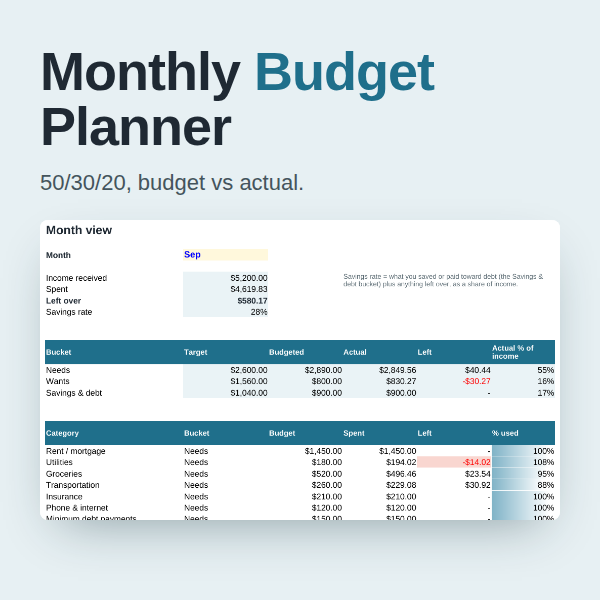
Monthly Budget Planner (50/30/20)
Your own split, up to 30 categories, month and year views, budget vs actual with overspending flagged, and your real savings rate.
✓ 0 formula errors · every month, bucket and category checked independently$9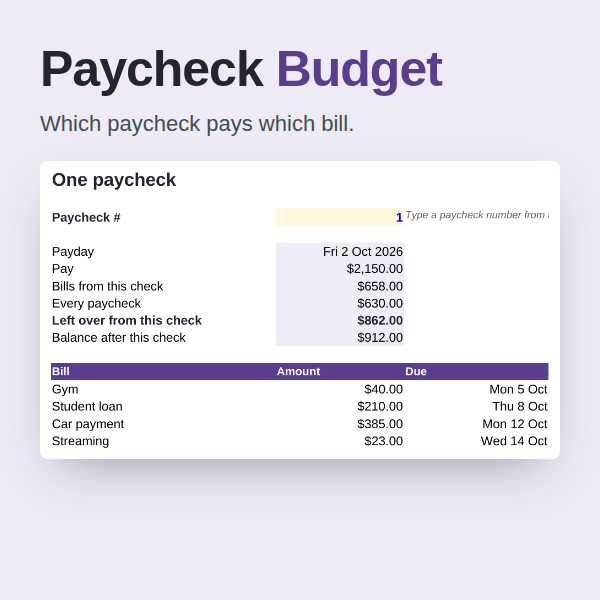
Paycheck Budget Planner
Every bill assigned to the paycheck before it's due, with what's left and your running balance for 12 months.
✓ 3,776 formulas · 0 errors · every bill's paycheck regenerated independently$8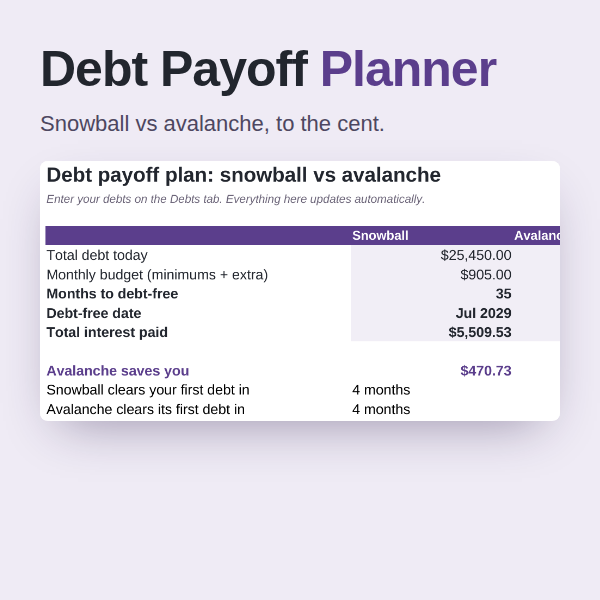
Debt Payoff Planner: Snowball vs Avalanche
Up to 15 debts: debt-free date and total interest for both methods, with the minimum rollover done right.
✓ 45,556 formulas · 0 errors · matches an independent month-by-month simulation$9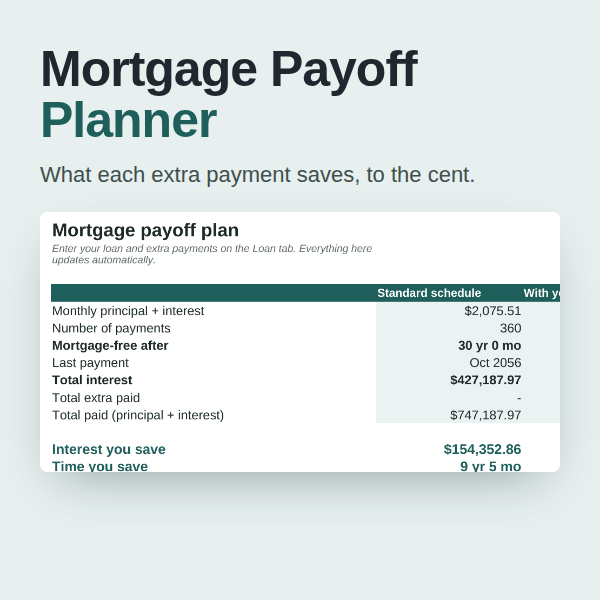
Mortgage Payoff Planner
What extra payments really save: new payoff date, interest and time saved, and the monthly extra that hits your goal.
✓ 6,261 formulas · 0 errors · matches an independent simulation to the cent$9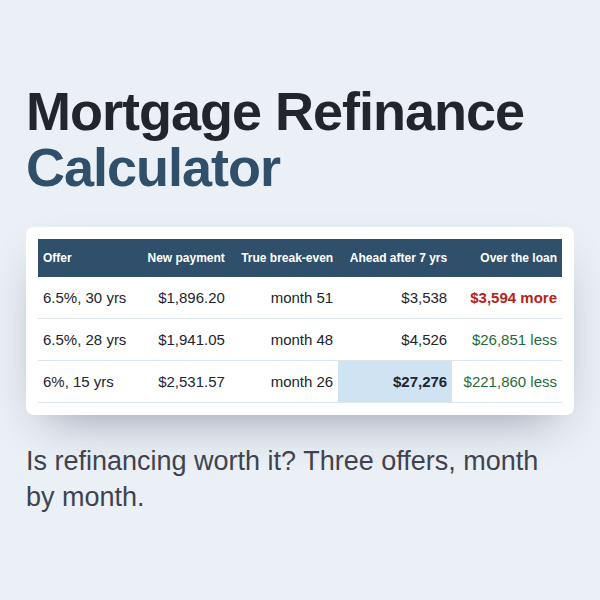
Mortgage Refinance Calculator
Your loan against three refinance offers: true break-even month, where you stand after your stay, and the lifetime cost.
✓ 7,235 formulas · 0 errors · every month of all four loans checked independently$7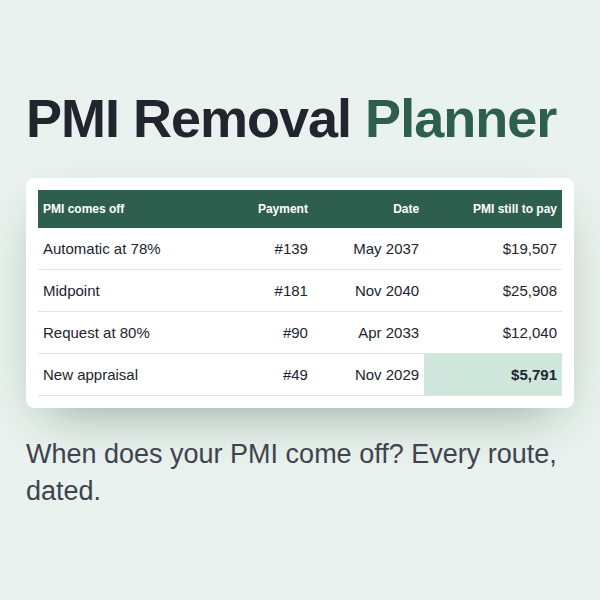
PMI Removal Planner
When PMI comes off by each route (78%, 80%, new appraisal), the PMI you'll still pay, and what extra payments save.
✓ 6,277 formulas · 0 errors · every route checked against a month-by-month simulation$6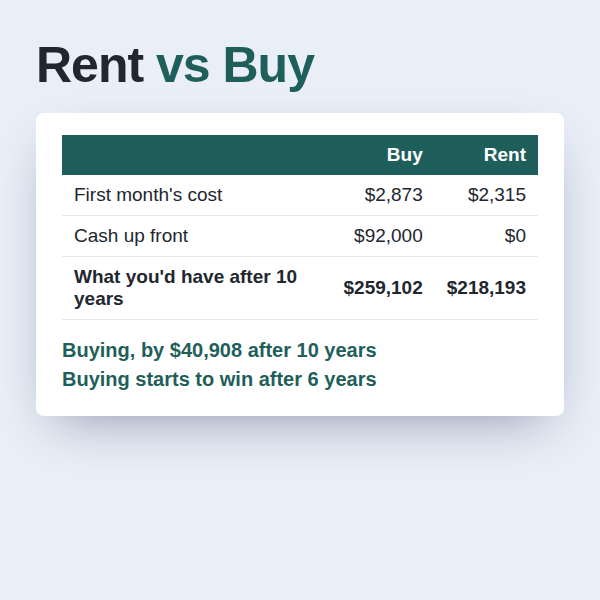
Rent vs Buy Calculator
Month by month: mortgage, PMI, taxes, upkeep and selling costs vs rent, with the difference invested. What you'd have, and the year buying starts to win.
✓ 5,883 formulas · 0 errors · 30 years checked against an independent simulation$9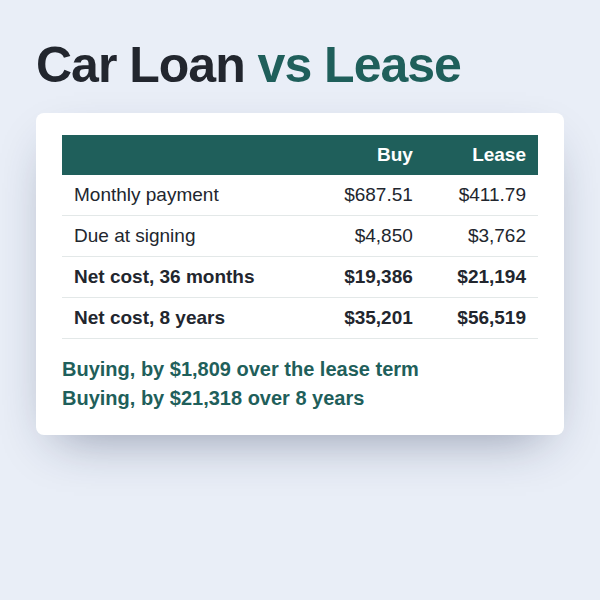
Car Loan vs Lease Calculator
Put a loan offer and a lease offer side by side: real lease math, the true cost over the lease term and over the years you'd keep the car.
✓ 779 formulas · 0 errors · every figure checked to the cent in 9 scenarios$8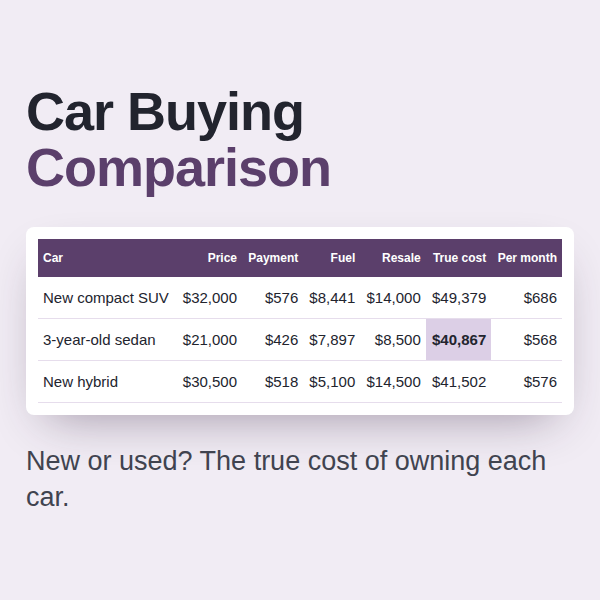
Car Buying Comparison
Three cars side by side: loan, interest, fuel, insurance, upkeep and resale, as a true cost per month and per mile.
✓ 0 errors · every result checked against a month-by-month loan simulation$6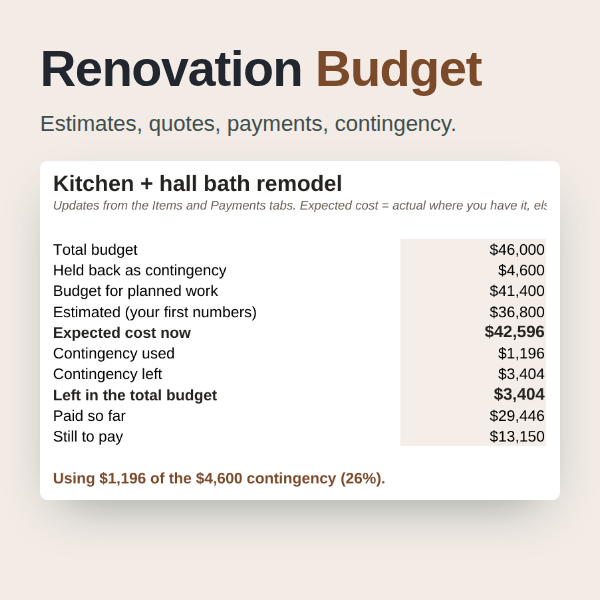
Renovation Budget & Bid Tracker
Every line item from estimate to final bill, every payment and contractor bid, and how much contingency is left.
✓ 649 formulas · 0 errors · every total recomputed independently$9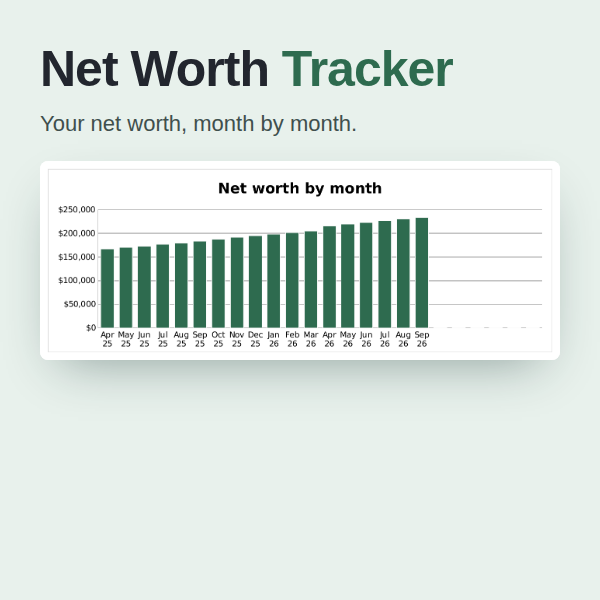
Net Worth Tracker
One balance per account per month: net worth, monthly and 12-month change, and where your money and debt sit.
✓ 440 formulas · 0 errors · dashboard recomputed independently in 8 scenarios$7
FIRE Planner
Your FI number, the year you reach it, coast FI, and years to FI at every savings rate, in today's dollars.
✓ 464 formulas · 0 errors · checked against a year-by-year simulation in 7 scenarios$8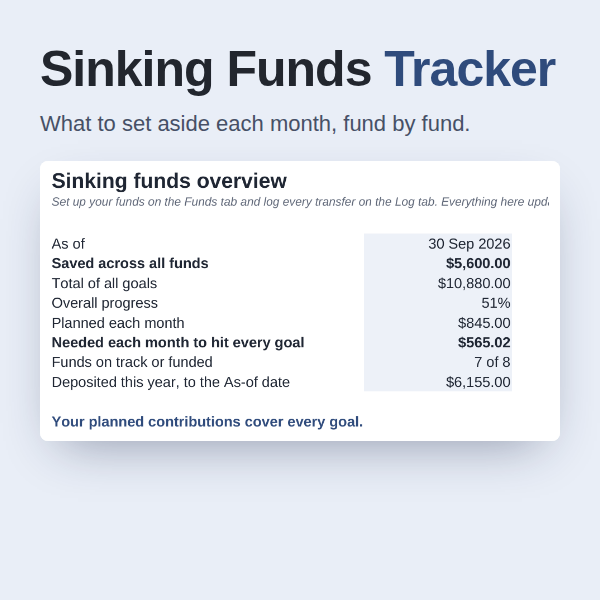
Sinking Funds Tracker
Every irregular bill in one place: what to set aside each month, which funds are on track, and what's short.
✓ 1,074 formulas · 0 errors · every balance and status recomputed independently$7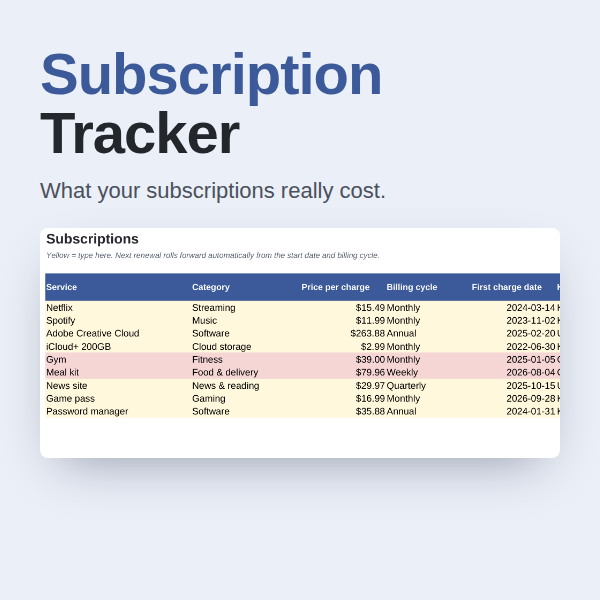
Subscription Tracker
True monthly and yearly cost of every subscription, next renewal dates, and what cancelling saves.
✓ 0 formula errors · costs and renewal dates checked independently$7
Wedding Budget Planner
Estimates that scale with your guest list, every deposit tracked, and a month-by-month plan of what's due before the day.
✓ 0 formula errors · estimates and cash plan checked independently$9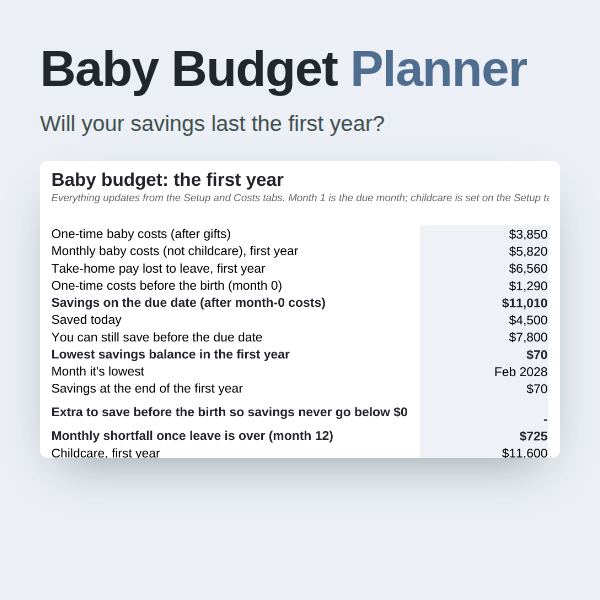
Baby Budget Planner
The first year month by month: leave pay, baby costs and childcare, and whether your savings last.
✓ 206 formulas · 0 errors · every month recomputed independently$7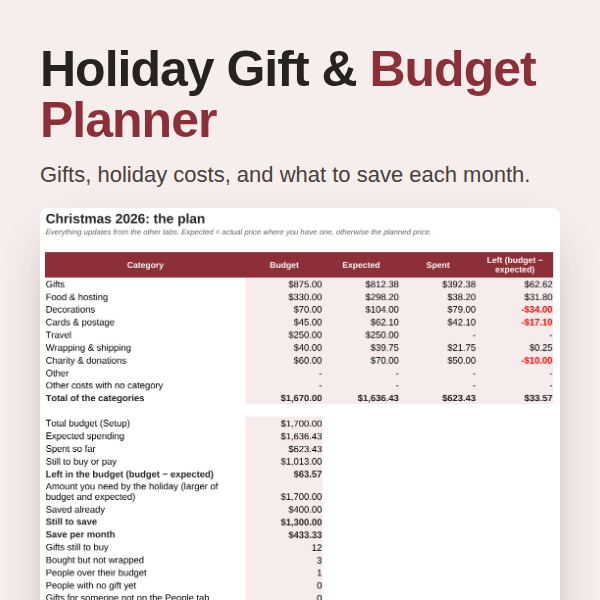
Holiday Gift & Budget Planner
Per-person gift budgets, a gift list, food, travel and decorations in one budget, and how much to save each month.
✓ 953 formulas · 0 errors · every gift, person and category recomputed independently$7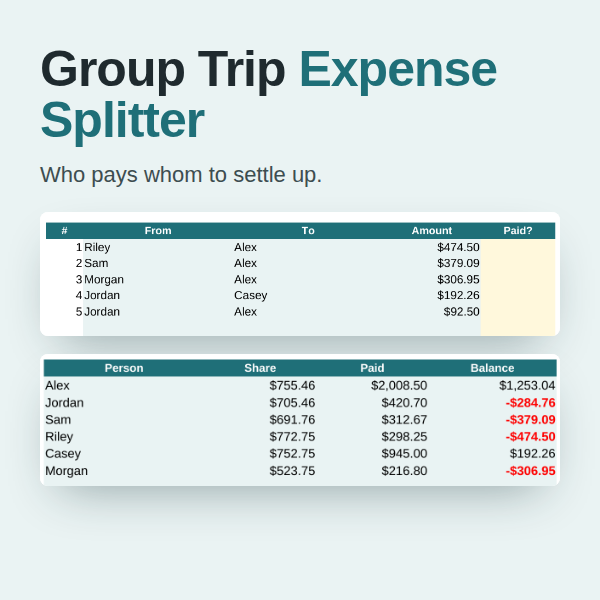
Group Trip Expense Splitter
Shared trip costs split equally or your way, each person's balance, and who pays whom to settle up.
✓ 3,175 formulas · 0 errors · every split and payment recomputed, settles to $0$7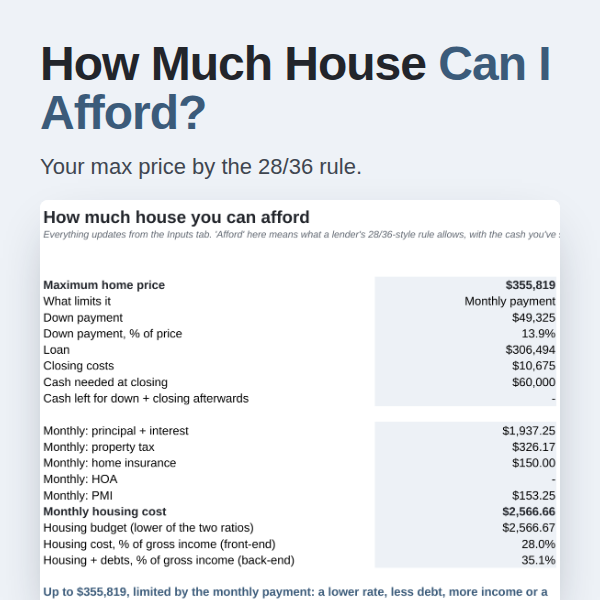
Home Affordability Calculator
How much house you can afford by the 28/36 rule, with PMI, taxes, closing costs and your cash, plus 5 homes checked.
✓ 1,018 formulas · 0 errors · max price checked against a closed-form solution$8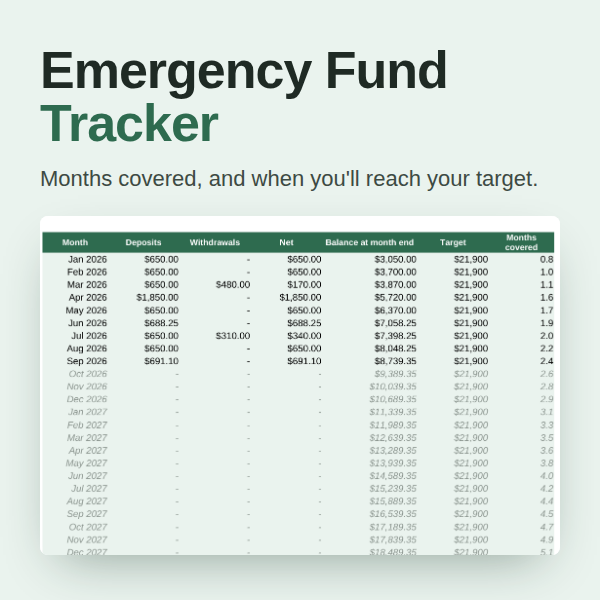
Emergency Fund Tracker
How many months you're covered, your target, and the month you'll reach each milestone.
✓ 490 formulas · 0 errors · plan and 24 months recomputed independently$6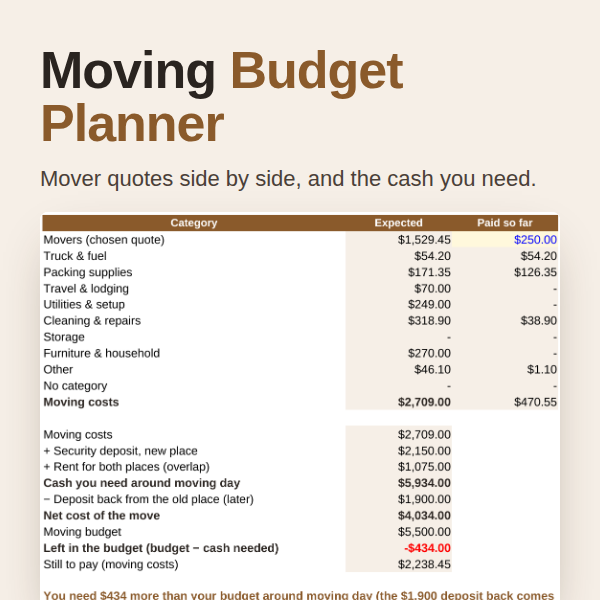
Moving Budget Planner
Mover quotes compared on the same total, every moving cost, and the cash you need on moving day.
✓ 215 formulas · 0 errors · every quote and cash figure recomputed$7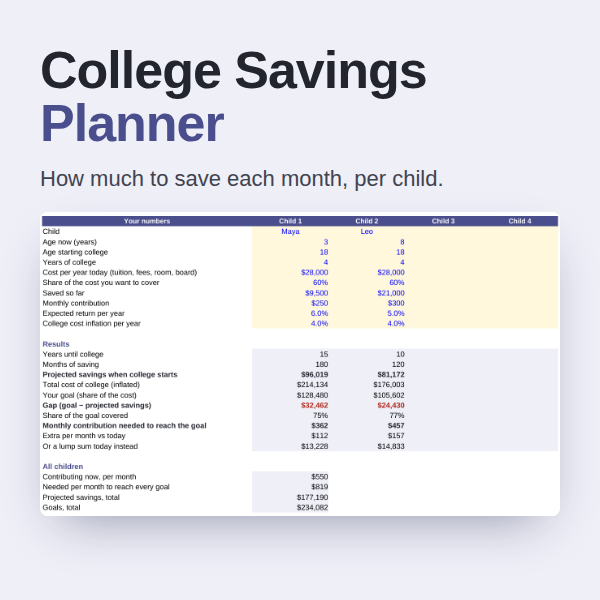
College Savings Planner
Projected 529 savings vs the inflated cost of college, the gap, and the monthly amount that closes it, for up to 4 children.
✓ 125 formulas · 0 errors · checked against a month-by-month simulation$7
Pet Budget & Expense Tracker
What each pet costs in a typical year and over its life, and where the money actually went, month by month.
✓ 205 formulas · 0 errors · budgets and the year recomputed from the log$6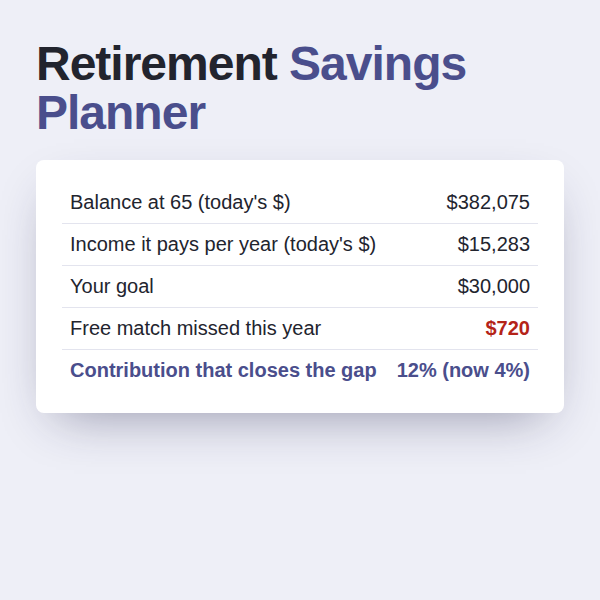
Retirement Savings Planner
Your 401(k) balance and income at retirement, the free employer match you're missing, and the contribution that reaches your goal.
✓ 3,106 formulas · 0 errors · checked against a year-by-year simulation$8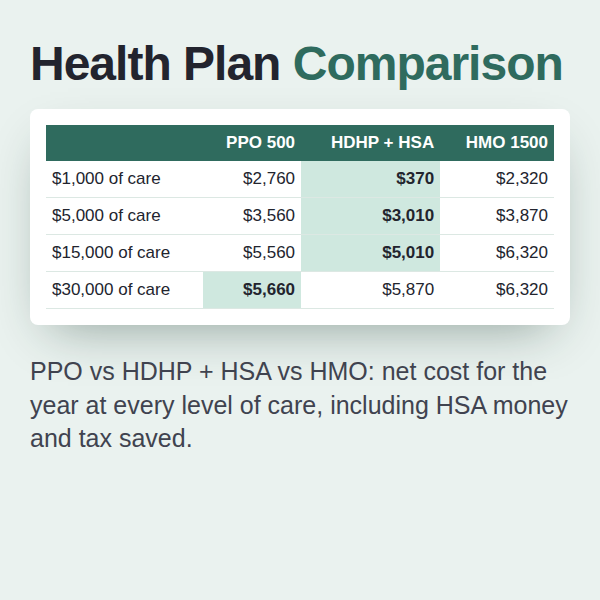
Health Plan Comparison
PPO vs HDHP + HSA vs HMO: what each plan really costs you in a year, at every level of medical spending.
✓ 106 formulas · 0 errors · checked claim by claim through the year$7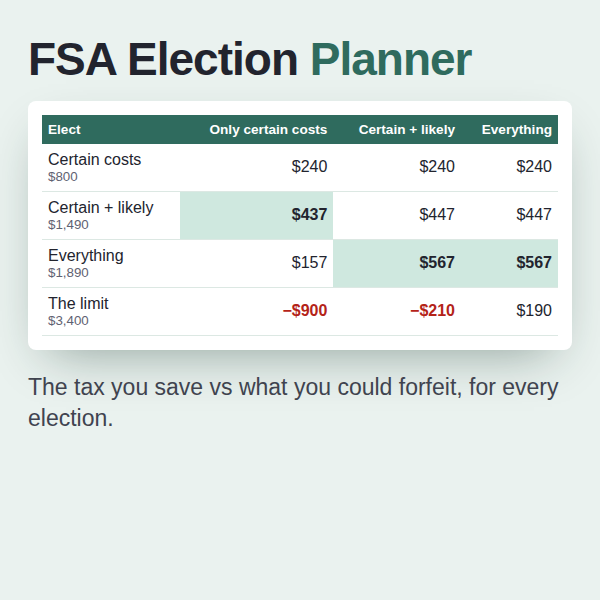
FSA Election Planner
How much to put in your health FSA: the tax you save vs what you could forfeit, plus a medical expense log.
✓ 103 formulas · 0 errors · checked claim by claim through the year$6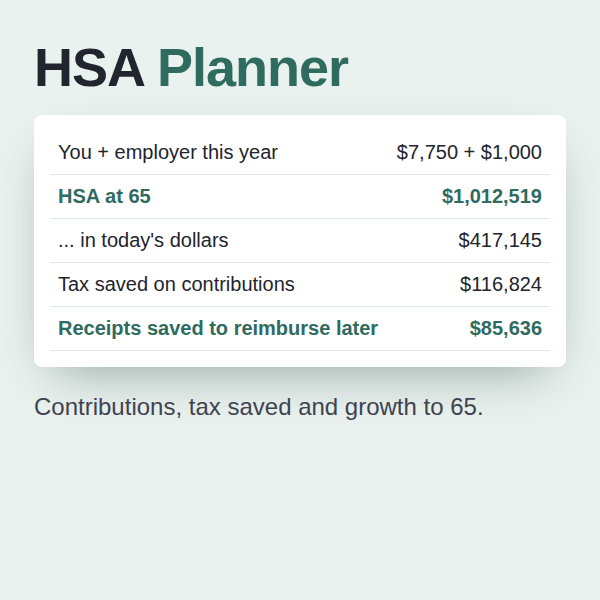
HSA Planner
Contributions within the limit, the tax you save, and your HSA year by year to 65: paying bills vs saving receipts.
✓ 513 formulas · 0 errors · every year checked independently$6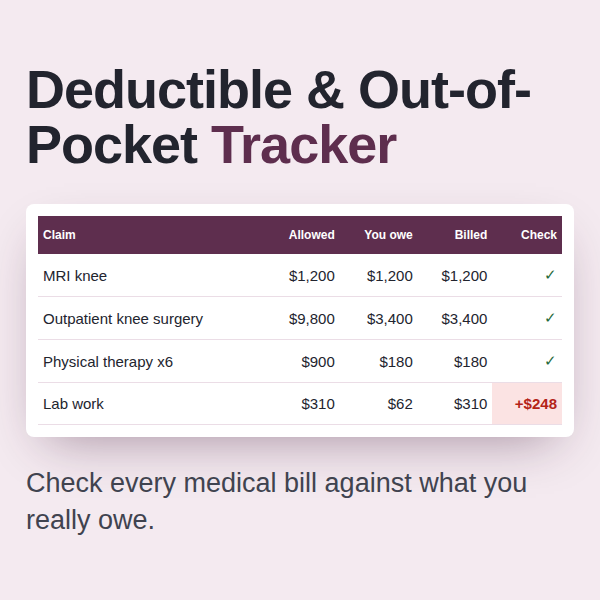
Deductible & Out-of-Pocket Tracker
What you should owe on each medical claim, mismatched bills, and your deductible and out-of-pocket progress.
✓ 1,013 formulas · 0 errors · every claim checked independently$6
Life Insurance Needs Calculator
How much life insurance your family would need, minus what you have: the gap to buy, next to the 10x and DIME rules.
✓ 172 formulas · 0 errors · lump sum checked year by year$5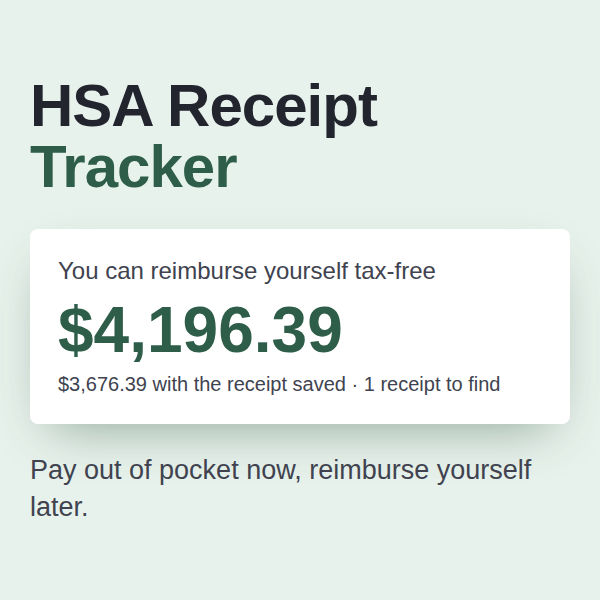
HSA Receipt Tracker
Every medical expense, what you can still reimburse from your HSA tax-free, missing receipts, and contributions vs the IRS limit.
✓ 1,023 formulas · 0 errors · every row checked independently$6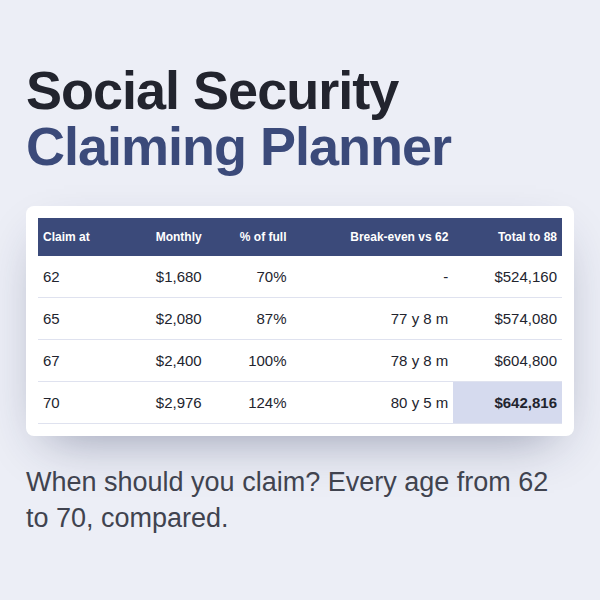
Social Security Claiming Planner
Claim at 62, 67 or 70? Monthly benefit at every age, break-even ages and lifetime totals.
✓ 240 formulas · 0 errors · SSA rules checked independently in 6 scenarios$7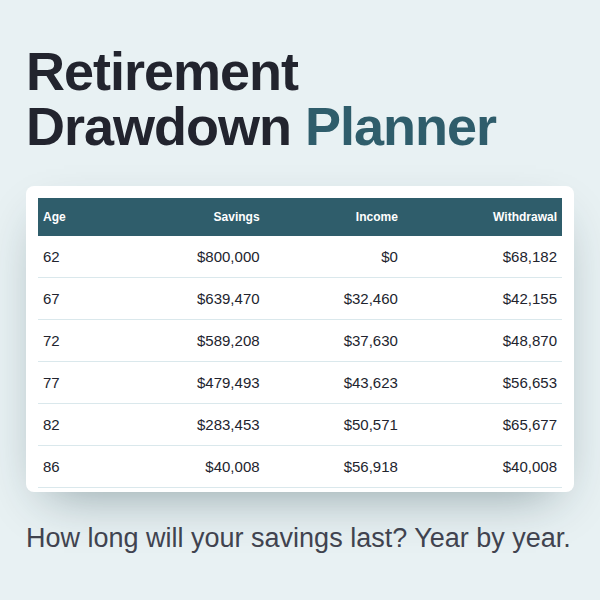
Retirement Drawdown Planner
How long your savings last with Social Security, taxes and inflation, and the most you can spend to last.
✓ 486 formulas · 0 errors · checked against a year-by-year loop and a bisection search$7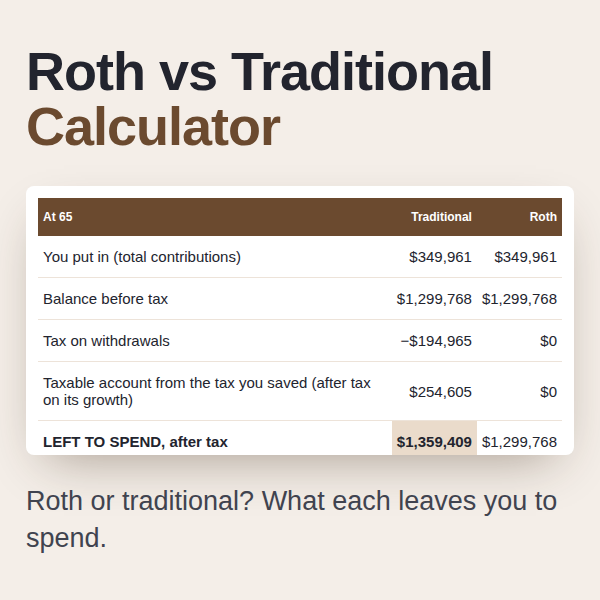
Roth vs Traditional Calculator
Roth or traditional 401(k)/IRA: what each leaves you to spend after tax, and the break-even tax rate.
✓ 363 formulas · 0 errors · checked independently, including the exact ties$6Guidesworked examples
- What happens to unused FSA money: the year-end deadline, grace period and carryover
Unused health FSA money is forfeited at plan-year end unless your employer's plan adds a grace period (2.5 more months, any amount) or a carryover (up to $680 for 2026 plan years) -- never both, and it's the employer's choice, not yours. Dependent care FSAs don't get the carryover. How to find out which one your plan has, and two worked examples.
- Trump Accounts 2026: the $1,000 seed, the $5,000 cap, and what's actually taxable at 18
A child born in 2026 whose family puts in $2,000 a year and claims the $1,000 federal seed has $68,374 in their Trump Account by the day they turn 18. Of that, $32,374 is taxable the moment it's withdrawn, plus a 10% early-withdrawal tax unless the beneficiary is 59½ or qualifies for an exception -- because at 18 a Trump Account becomes an ordinary traditional IRA, not a special tax break. Six worked examples built from 26 U.S.C. section 530A, section 128, and section 6434, including a $1,000 seed missed by one birth year and the $5,000/year combined contribution cap.
- The $6,000 senior deduction: how OBBBA's enhanced deduction for seniors actually phases out
A married couple filing jointly where both spouses are 65+ gets up to $12,000 off the top of their income starting in 2025 -- but it phases out at the exact same $250,000 MAGI as a couple with only one qualifying spouse, not at $350,000. Worked examples built from 26 U.S.C. section 151(d)(5)(C) and IRS Schedule 1-A, including the single/HOH $175,000 full-phase-out point, the married-filing-separately block, and the 2029 sunset.
- SALT deduction cap 2026: the $40,000 limit, the MAGI phase-down, and the MFS floor trap
The OBBBA raised the federal cap on itemized state and local tax (SALT) deductions from $10,000 to $40,000 for 2025, rising 1%/year through 2029 before reverting to $10,000 in 2030, with a 30%-of-excess MAGI phase-down above $500,000. It only matters if you itemize, and married filing separately gets a halved cap, a halved threshold, and an effectively halved $5,000 floor through a quirk in how the statute is structured. Five worked examples, including MFS and full phase-out.
- Qualified charitable distributions in 2026: the age rule, the $111,000 limit, and your RMD
From age 70½ you can send up to $111,000 a year straight from a traditional IRA to charity in 2026 -- tax-free, and counting toward your RMD if you're old enough to have one. Who qualifies, what it does to your AGI, and two worked examples, including a couple where only one spouse is old enough to use it.
- No tax on tips and no tax on overtime: the 2026 deduction, who qualifies, how much
Up to $25,000 of tips and $12,500-$25,000 of overtime premium pay can come off your federal taxable income for 2025-2028, if your occupation and employer qualify and your income isn't too high. The caps, the occupation and FLSA gates, the exact phase-out math, and five worked examples.
- No tax on car loan interest: the 2026 auto loan interest deduction, who qualifies, how much
Up to $10,000/year of interest on a qualifying new, US-assembled vehicle loan can come off your federal taxable income for 2025-2028, if the vehicle, the loan and your income qualify. The vehicle and loan rules, the MAGI phase-out math (it rounds the opposite way from the tips and overtime deductions), and five worked examples.
- Gambling loss deduction 2026: the OBBBA's 90% rule and the phantom-income trap
Starting with the 2026 tax year, the OBBBA caps the itemized deduction for gambling losses at 90% of those losses, still capped at winnings as before. A gambler who wins and loses the same $50,000 used to owe $0 in gambling tax; now they owe tax on $5,000 of income they never actually kept. Six worked examples, including the break-even and net-loss "phantom income" cases, and the status of the bill trying to reverse it.
- Year-end tax moves for 2026: a checklist with the numbers, before December 31
Six year-end tax moves for 2026 with worked numbers, not generalities: the RMD deadline and its 25% penalty, QCD vs. cash giving, the FSA deadline and carryover, maxing an HSA or 401(k), filling the 12% Roth conversion bracket, and tax-loss harvesting.
- The backdoor Roth IRA pro-rata rule: when it's NOT tax-free (Form 8606, worked)
A backdoor Roth is only tax-free if you have no other pre-tax IRA money. With $93,000 in an existing traditional IRA and a new $7,000 nondeductible contribution converted the same year, $6,510 of the conversion is taxable -- not $0. The IRS Form 8606 pro-rata math, worked three ways, plus the 401(k)-rollover fix.
- Medicare Advantage vs. Original Medicare (2026) -- and the HSA trap if you're still working past 65
Original Medicare vs. Medicare Advantage for 2026 Open Enrollment (Oct 15 - Dec 7): provider networks, Medigap, Part D, and out-of-pocket maximums, with the official 2026 Part A and Part B costs. Plus the HSA trap few sites cover -- enrolling in Medicare Part A after 65 can be backdated up to 6 months and turn recent HSA contributions into an excess contribution with a 6% excise tax.
- Mandatory Roth catch-up contributions in 2026: the $150,000 wage rule
Starting in 2026, 401(k)/403(b)/governmental 457(b) catch-up contributions must be Roth if you're 50+ and your prior-year FICA wages from that employer topped $150,000. Who's affected, worked examples, and what to do if your plan has no Roth option.
- IRMAA 2026: Medicare's income surcharge is a cliff, not a phase-in
The full 2026 IRMAA tier table for Medicare Part B and Part D, both filing statuses, with a worked example showing how a $200 difference in MAGI two years ago adds $1,736.40 a year to Medicare premiums -- and why a December Roth conversion or QCD choice today sets the MAGI that triggers it.
- How to appeal a Medicare IRMAA surcharge: Form SSA-44 and the 8 life-changing events
How to appeal an IRMAA Medicare surcharge with Form SSA-44 after a life-changing event -- the 8 events SSA recognizes (marriage, divorce, death of a spouse, work stoppage or reduction, loss of income-producing property, loss of pension income, employer settlement payment), the exact evidence each one requires, how and where to file, and what SSA does if it approves the request.
- How much will my prescriptions cost under Medicare Part D in 2026?
The 2026 Medicare Part D standard benefit, phase by phase: the $615 deductible, 25% initial-coverage coinsurance, and the $2,100 annual cap on cash out-of-pocket drug costs, with worked examples.
- How much of your Social Security is taxable? The IRS Publication 915 worksheet, worked out
Up to 85% of Social Security benefits can be federally taxable -- never all of it -- based on "provisional income," not just your benefit. A single filer with $20,000 in Social Security and $30,000 of other income owes tax on $9,600 (48%) of it; a couple with $30,000 in benefits and $120,000 of other income hits the 85% cap, $25,500 taxable.
- FSA vs HSA: which should you choose during open enrollment
During open enrollment (Oct 15 - Dec 7, 2026), a general-purpose health FSA and an HSA-eligible HDHP are usually mutually exclusive -- IRS Publication 969 treats the FSA as "other health coverage" that disqualifies you from the HSA. The fix is often a limited-purpose or post-deductible FSA instead. A worked example of what re-electing the wrong FSA out of habit costs in lost HSA tax savings.
- 52-week savings challenge 2027: full schedule by date, plus 100-envelope and 26-paycheck totals
The 52-week money challenge for 2027, week by week with real dates (starts Monday, January 4): $1,378 total, deposits $1 to $52. Plus the 100-envelope ($5,050) and 26-paycheck ($1,755) challenges, and what doubling or tripling the amounts gets you.
- 2026 capital gains tax: how much on a $20,000 gain by income (single & married)
The 2026 long-term capital gains brackets (0% to $49,450 single / $98,900 joint, 15% up to $545,500 / $613,700, 20% above) and the tax on a $20,000 gain at ordinary incomes from $30,000 to $700,000, stacked the way the IRS actually taxes it.
- Standard vs extended vs graduated student loan repayment: what each really costs
One $48,500 loan at 6.05%, repaid three ways: $539.67 a month for 10 years, $313.97 for 25 years, or $452.24 rising to $662.12. The extended plan costs $29,431 more in interest. What an extra payment does, and which plans are still open after July 2026.
- How a CD ladder works: a $25,000 example, month by month
How to build a CD ladder: split your savings into CDs of 1 to 5 years so one matures every year, what each is worth when it matures, and what the ladder earns vs a savings account and one long CD, with worked examples.
- When does PMI come off? Payment-by-payment dates for 3% to 15% down, and what extra payments change
On a $350,000 home at 6.5%, PMI can be cancelled on request at payment 124 with 5% down and payment 56 with 15% down; automatic removal comes 11–19 payments later. $200 a month extra brings the 5%-down date to payment 84 and saves $5,542 of PMI.
- What's a good debt-to-income ratio? Your housing budget by income at 28/36, 43% and 50%
How front-end and back-end debt-to-income ratios work, a worked example at $85,000 a year, and a table of the most you could spend on housing at incomes from $50,000 to $200,000 with $0, $500 or $1,000 of other debt payments.
- What investing $100 to $1,000 a month grows to in 10, 20, 30 and 40 years
$500 a month at 7% a year grows to $85,526 in 10 years, $253,768 in 20, $584,726 in 30 and $1,235,771 in 40. Tables for $100 to $1,000 a month at 5%, 7% and 9%, and why starting 10 years earlier is worth more than doubling the amount.
- Social Security break-even age: claiming at 62 vs 67 vs 70, worked out
With a $2,000 benefit at 67, claiming at 62 pays $1,400 a month and claiming at 70 pays $2,480. Waiting until 67 catches up with 62 at age 78 and 8 months; waiting until 70 catches up at 80 and 5 months, and passes claiming at 67 at 82 and 6 months.
- Roth or traditional 401(k)? Which leaves more at 65, by tax rate now and in retirement
$7,000 a year from 30 to 65 at 7%: who comes out ahead, and by how much, for tax rates of 12% to 32% now and 10% to 32% in retirement. Why the break-even is your current rate for the same take-home cost, and lower (19.6% at 22% now) when you max out.
- Rent vs buy by price-to-rent ratio: when buying pulls ahead at ratios from 10 to 30
The year buying pulls ahead of renting for a $400,000 home at price-to-rent ratios from 10 to 30, at 5.5%, 6.5% and 7.5% mortgage rates and 2%–5% home price growth. At a ratio of 15 buying wins in year 8; at 20 it doesn't within 30 years.
- RMD table for 2026 and 2027: how much you must take out, by age
Your required minimum distribution is last year's December 31 balance divided by an IRS divisor for your age. The divisors, the RMD per $100,000 at each age, when your first RMD is due, and what delaying the first one to April 1 costs.
- Qualified charitable distributions in 2026: when giving from your IRA beats giving cash
From 70½ you can give up to $111,000 a year straight from an IRA to charity in 2026, tax-free and counting toward your RMD. How that compares with taking the RMD and giving cash under the new 2026 deduction rules, with tables.
- Pension lump sum or monthly payments? Break-even age and the return a pension pays
A pension offer of $2,000 a month from 65 or $300,000 now, worked through: what the pension is worth at different returns, the break-even age, the return the pension pays if you live to 80, 90 or 100, and what a cost-of-living raise changes.
- Pay off the mortgage early or invest? $500 a month over 30 years, worked out
$500 a month extra on a $300,000 mortgage at 6.5% pays it off in 210 payments instead of 360. Investing the $500 instead comes out ahead after 30 years only if returns beat about 6.7% a year, the mortgage rate compounded monthly. Tables at 5%, 6.5% and 7.5% mortgage rates.
- Open enrollment for 2027: HSA, HDHP and dependent care FSA limits, and HSA per paycheck
The benefit numbers you choose this fall apply to 2027: HSA $4,500 / $9,000, HDHP minimum deductible $1,750 / $3,500, dependent care FSA $7,500. What each is, what isn't announced yet, and HSA contributions per paycheck.
- Mortgage payment table: $200,000 to $600,000 at 5.5% to 7.5% (30 and 15 years)
Monthly principal and interest on $200,000 to $600,000 at 5.5%, 6%, 6.5%, 7% and 7.5%, for 30- and 15-year loans, and the total interest over 30 years. A $400,000 loan at 6.5% is $2,528.27 a month and $510,180 of interest over 30 years.
- Is refinancing worth it? Break-even months for a $300,000 mortgage, and the trap in resetting to 30 years
Refinancing $300,000 with 28 years left and $6,000 closing costs: a 1-point drop breaks even in about 17 months; a half-point drop takes 51 months if you reset to 30 years, and costs $3,594 more over the life of the loan. Tables for 7%–8% current rates.
- Inherited IRA: the 10-year rule, yearly RMDs and how to spread the withdrawals
If you inherited a traditional IRA from someone who died in 2020 or later, you probably have to empty it within 10 years, and may owe a minimum every year before that. Which rule applies, how the yearly RMD is worked out, and a $400,000 example taken out two ways.
- How to check a medical bill against your EOB: a worked example with deductible, coinsurance and out-of-pocket max
Seven claims on a $3,000 deductible, 20% coinsurance plan, worked through in date order: $4,932 is owed, and a $310 lab bill should be $62. Why the order of claims matters, and what happens at the out-of-pocket maximum.
- How much will an HSA or 401(k) contribution reduce my paycheck? Tables for 2027
A pre-tax deduction takes less from your take-home pay than it puts away. Tables: the 2027 HSA maximum per paycheck by tax bracket, and $500 a paycheck to a pre-tax 401(k), a Roth 401(k) or through the cafeteria plan.
- How much to save each paycheck for Christmas 2026 (weekly, biweekly, twice a month)
Starting in October, there are 12 weekly Friday paydays before Christmas 2026, 6 biweekly ones on either schedule, and 5 twice-monthly ones. To have $1,000 by December 18: $83.34 a week, $166.67 every two weeks or $200 twice a month. Tables for $500 to $3,000, and what waiting until November costs.
- How much life insurance do I need? A worked example against the 10× and DIME rules
A family with $70,000 of take-home pay, two children and a $280,000 mortgage would need about $1,075,149; with savings and cover through work, the gap is $890,149. The 10× rule says $700,000 and DIME says $1,693,000. What moves the number most.
- How much car can I afford? The 20/4/10 rule by income, worked out
The 20/4/10 rule (20% down, 4-year loan, car costs under 10% of gross income) worked out for incomes from $40,000 to $150,000 at 7%: $26,100 on $60,000 with nothing for insurance, $18,270 with $150 a month of insurance. What 5- and 6-year loans and other rates do to the number.
- How much can I spend in retirement? $800,000 at 62, with Social Security from 67 and tax on withdrawals
Retiring at 62 with $800,000 and $28,000 a year of Social Security from 67: spending $60,000 a year runs out at 86, while $54,427 lasts to 95. Tables by savings, spending, plan age, return, tax and claiming age.
- How long to pay off student loans: 10-year vs 25-year payments and what $100–$500 extra saves
Monthly payment and total interest for $20,000 to $100,000 of student loans on a 10-year and a 25-year schedule at 5.5%, 6.5% and 7.5%, and how many months $100, $200 or $500 extra a month takes off. $30,000 at 6.5% with $200 extra is paid off in 67 months and saves $5,100.
- How long to pay off a credit card with minimum payments (and what keeping the first payment fixed saves)
$10,000 at 24% APR paid at the minimum (1% of the balance plus interest, at least $25) takes 25 years 3 months and $18,887 of interest. Keep paying the first month's $300 instead and it's gone in 4 years 8 months with $6,644 of interest. Tables for $2,000 to $20,000 at 20%, 24% and 29%.
- HSA limit for a partial year: month by month, or the last-month rule (2027 tables)
Starting a high-deductible plan mid-year, switching to family coverage or enrolling in Medicare changes your HSA limit. How the month-by-month limit and the last-month rule work, with 2027 tables and the IRS examples.
- Family health insurance: my plan, my spouse's, or split? A worked example
When both parents can get health insurance at work, splitting the family between the two plans can beat putting everyone on one. A worked example with a spousal surcharge, embedded vs aggregate deductibles, and what changes when one person has a costly year.
- Estimated tax for 2026: the safe harbor and how to catch up by January 15
How much estimated tax you must pay for 2026 to avoid the underpayment penalty: 90% of this year's tax or 100% of last year's (110% above $150,000 of income), with worked examples and what to do if you're behind before the January 15, 2027 payment.
- Dependent care FSA or child care credit in 2026? Worked examples by tax bracket
2026 changed both sides: the dependent care FSA limit rose to $7,500 and the child care credit to up to 50%. Worked examples by tax bracket, the credit rate at every income, and why splitting between the two is usually the worst choice.
- 72- or 84-month car loan? What the lower payment costs, by term and rate
$35,000 financed at 6.9%: 84 months instead of 60 cuts the payment by $164.86 but adds $2,745.12 of interest, and after 3 years you'd still owe $22,031 instead of $15,458. Tables for 36 to 84 months at 4.9%, 6.9% and 9.9%.
- 2026 tax brackets: how much federal income tax on $40,000 to $300,000
The 2026 federal tax brackets and standard deductions, and what they add up to: tax, bracket and average rate at incomes from $40,000 to $300,000 for single, head of household and joint filers, plus what the new $6,000 senior deduction saves.
- Years to financial independence by savings rate: the table, at 3%, 5% and 7% returns
Starting from zero, saving 20% of take-home pay reaches financial independence in about 37 years at a 5% real return; 50% takes 17. The full table at 3%, 5% and 7%, why your income drops out of the math, and what a head start does.
- What skipping part of your 401(k) match costs: $720 a year becomes $133,000
A worked example: $72,000 salary, 4% contributed, 50% match up to 6%. The $720 of match left on the table this year, and what the two missing points cost by 65, in today's dollars and in retirement income.
- Rent vs buy: when does buying actually pull ahead? (a $400,000 home, year by year)
A $400,000 home with 20% down at 6.5%, against $2,300 rent: renting is ahead for 5 years and buying pulls ahead in year 6, then by $40,908 after 10 years. How home prices, rent, the mortgage rate and investment returns move the break-even year.
- Moving costs: 4 mover quotes compared on the same total, and the cash you really need
Four quotes for one apartment move, from $1,529 to $2,990 once fees, packing and tips are in. Why the lower hourly rate was the more expensive quote, when the hourly mover stops beating the flat one, and why a $4,034 move needed $5,934 on the day.
- How to split group trip expenses fairly: a 6-person ski weekend, settled in 5 payments
Six friends, 12 shared payments, $4,201.92. Why splitting everything evenly overcharges the one who didn't ski by about $177, and how 41 separate pay-backs collapse into 5 payments.
- How much to save for college each month: a worked 529 example for two kids
Two kids, aged 3 and 8, and a goal of covering 60% of a college that costs $28,000 a year today. The inflated cost, the gap, the $819 a month that closes it, and why starting at birth costs $373 a month where starting at 8 costs $644.
- How much to save before a baby: the first year, month by month (worked example)
A two-income family with 4 + 1 months of leave and daycare from month 5: $11,010 saved by the due date lasts the first year with $70 to spare, and hides a $725-a-month shortfall once leave ends. How to run the numbers for your own plan.
- How much to put in your FSA: a worked example with the 2026 limit and carryover
A worked FSA example: $800 of certain costs, $690 likely, $400 maybe. What each election saves in tax and what it could forfeit, with and without the $680 carryover, and the rule behind it: elect a cost only if you're more than 1 − your tax rate sure of it.
- How much to put in your 401(k) by age: the contribution rate that reaches your goal
The 401(k) rate you need by starting age (25–55) and salary ($50k–$150k) to retire at 65 on 40% of today's pay: 9%, 12%, 16%, 23%, 33% from nothing; 9–15% with savings built.
- How much to budget for Christmas: an example $1,700 plan, per person and per month
An example Christmas for 13 people: $812 of gifts, and $824 of food, travel, decorations, cards and charity. Where it ran over, who went over budget, and why it takes $433 a month from October to pay for it all by the 25th.
- How much rent can I afford? The 30% rule, the 40x rule and your take-home pay
Rent by income from $30,000 to $150,000 under the 30% rule and landlords' 40x and 3x rules. The 40x rule is the 30% rule in disguise, and 30% of gross is closer to 40% of take-home pay.
- How much house can I afford on $50k, $75k, $100k, $150k or $200k a year?
Maximum home price by income ($50,000 to $250,000) and cash to put in ($30,000, $60,000 or $120,000), by the 28/36 rule at 6.5%. Where cash, not income, sets the limit, and the PMI cliff at 20% down.
- How much house can I afford on $110,000 a year? The 28/36 rule, worked through
$110,000 income, $650 a month of debts, $60,000 to put down, 6.5% for 30 years: up to $355,819. What moves that number, from $1,200 of debts (−$58,759) to a $300 HOA (−$37,774) and why insisting on 20% down cuts it to $260,870.
- How much does a dog cost per year? A worked budget for a dog and a cat, and 9 months of real spending
A medium dog budgeted at $3,581 a year and a cat at $1,862: line by line, what each costs over the rest of its life, and how nine months of real spending came in $108 over, mostly because of one vet visit nobody planned.
- How much contingency does a remodel need? An example budget, line by line
An example kitchen and bath remodel: estimates of $36,800 became an expected $42,596, 15.75% more. Labor ran 34.9% over, a subfloor repair nobody planned added $1,850, and a 10% contingency covered it. How to size and track yours.
- How long will $500,000 last in retirement? A table by withdrawal and return
How many years $500,000 pays $20,000 to $60,000 a year (in today's dollars) at real returns of 0% to 4%, plus $250,000, $750,000 and $1 million at 3%, and the withdrawal each can pay forever.
- How long does it take to build an emergency fund? A 9-month example, and the math for yours
$3,650 a month of essentials, a 6-month target of $21,900. Nine months of $650 deposits, a tax refund and two real emergencies later: $8,739.35 saved, 2.4 months covered, 3 months by January and the full target 21 deposits away.
- HSA: pay medical bills from it, or pay yourself and save the receipts?
A worked HSA example from age 35 to 65: maxing a family HSA with $1,800 a year of medical bills. Paying the bills from the HSA leaves $813,546; paying them yourself and saving the receipts leaves $1,012,519 plus $85,636 you can reimburse tax-free.
- HDHP vs PPO: when the high-deductible plan with an HSA really costs less
A worked open-enrollment example: a $180-a-month PPO against a $60-a-month HDHP with a $3,300 deductible. The HDHP costs less up to $18,250 of care, but only because of the HSA money. Without it, the PPO wins from about $2,300.
- Car loan payment table: $20,000 to $50,000 over 36 to 84 months
Monthly payment and total interest for $20,000, $30,000, $40,000 and $50,000 car loans over 36 to 84 months at 7% APR, and for $35,000 at 0% to 14%. What a longer term really costs.
- 3-paycheck months in 2027: which months, and why 2027 has 27 paydays for some
Paid every other Friday? In 2027 your 3-paycheck months are January, July and December (27 paydays) or April and October (26), depending on your cycle. Weekly Friday pay has five 5-paycheck months.
- 15-year vs 30-year mortgage on $300,000: the payment, the interest, and the option in between
$300,000 at 6.5%: $1,896.20 a month for 30 years ($382,637 of interest) or $2,613.32 for 15 ($170,398). Paying the 30-year loan like a 15-year costs the same interest at the same rate, so the 15-year's real edge is its lower rate.
- Where a year of net worth growth comes from: a $50,586 example, account by account
One household's net worth rose $50,586 in 12 months. Account by account: $24,456 from retirement accounts, $12,635 from paying down debt, $7,000 from a home estimate and −$3,120 from the car. How to read your own number without fooling yourself.
- What subscriptions really cost per year: weekly vs monthly vs quarterly vs annual plans
A $79.96 weekly meal kit is $4,157.92 a year; a $29.97 quarterly plan and a $9.99 monthly plan both cost $119.88. How to compare billing cycles, and why weekly plans are the ones to check first.
- Wedding cost per guest at 50, 80, 110, 150 and 200 guests: why bigger costs more but less per head
With the same vendors, 200 guests cost $38,200 in total but $191 each; 50 guests cost $24,025 but $480.50 each. Fixed costs, per-guest costs, and how the guest count moves both.
- The 50/30/20 rule on a real $5,200 budget: where it holds and where it breaks
One household's September on $5,200 take-home: needs came to 55%, wants 16%, savings 17%, plus $580 left over. What the 50/30/20 rule gets right, where rent breaks it, and how to measure your real savings rate.
- Sinking funds: how much to save each month for irregular bills (worked example with 8 funds)
A sinking fund turns a big irregular bill into a small monthly transfer. Eight real-looking funds, $10,880 of goals: what's needed per month for each, why the total ($565.02) changes every month, and how to spot a fund falling behind.
- Lease vs buy a car: the lower payment isn't the cheaper deal (worked example)
A $42,500 SUV: $411.79 a month to lease, $687.51 a month to buy. Over the 36 months, buying still costs $1,809 less. How to compare the two offers on net cost, the resale value where they break even, and why your mileage can flip the answer.
- How to budget by paycheck: which paycheck pays which bill (biweekly worked example)
Paid every other Friday? Assign each bill to the last paycheck before it's due. A worked example with $2,150 paychecks and 11 bills: why the check before rent always looks short, why that's fine if leftovers carry forward, and the two months with a third paycheck.
- How much does an extra mortgage payment save? $100 to $1,000 a month on a $300,000 loan
On a $300,000, 30-year mortgage at 6.5%, an extra $100 a month saves $60,995.81 of interest and 4 years; $200 saves $103,450.19 and almost 7 years. A table at 6%, 6.5% and 7%, plus biweekly, yearly and lump-sum payments compared.
- How long to pay off a credit card: table by balance, APR and monthly payment
Months to pay off $2,000, $5,000 and $10,000 at 18%, 24% and 29% APR with fixed payments of $100 to $500, and the total interest each way. Paying $200 instead of $100 can halve the time.
- Debt snowball vs avalanche with real numbers: 5 debts, $25,450, month by month
The same five debts paid off both ways. The avalanche saves $470.73 and one month; the snowball clears three debts much sooner. Which debt goes when, and when the choice matters.
- A $30,000 wedding for 110 guests: the budget breakdown, per-guest costs and payment timeline
How a $30,000 budget splits across venue, catering and 12 other categories for 110 guests, why per-guest costs decide the total, and why the final month is the expensive one.